

Celebrate different cultures and traditions
Cultures and Traditions
CHRISTMAS
Christmas Traditions in England
Christmas traditions in England include decorating homes with trees and lights, exchanging cards, and children hanging stockings for "Father Christmas" (Santa Claus) to fill. Christmas dinner is a large meal, often with turkey and trimmings, followed by Christmas pudding. Other key traditions are pulling Christmas crackers, attending pantomimes, and the King's Christmas message on TV. There are also family and local traditions that could be discussed.
Pre-Christmas
- Decorating: Families decorate their homes with lights and Christmas trees, often in early December.
- Advent calendars: Many people use Advent calendars to count down the days to Christmas.
- Christmas cards: Exchanging cards is a common tradition.
- Carol singing: People gather to sing Christmas carols.
- Letters to Father Christmas: Children write letters to Father Christmas, sometimes throwing them in the fireplace so the smoke carries them up the chimney.
Christmas Eve
- Stockings: Children hang stockings for Father Christmas to fill with small gifts and sweets.
- Food and drink: Some families leave out food and drink for Father Christmas, such as mince pies and a drink.
- Church services: Many people attend church services on Christmas Eve.
Christmas Day
- Presents: Children open presents, both those in stockings and gifts left under the tree.
- Christmas dinner: The main event is a large meal, typically featuring turkey, roast potatoes, and various vegetables like Brussels sprouts and carrots.
- Christmas crackers: Families pull Christmas crackers at the dinner table, which contain a small toy, a joke, and a paper hat.
- The King's speech: After dinner, many people watch the King's Christmas speech on TV.
After Christmas
- Boxing Day: The day after Christmas is Boxing Day, a public holiday for visiting family and friends or giving small gifts to those who have provided a service.
- Pantomime: During the festive season, families may go to a pantomime, a family-friendly musical show based on a fairytale.
- Mince pies and mulled wine: The festive treats of mince pies and mulled wine are enjoyed throughout the season.
Christmas traditions vary globally, from unique food to specific rituals. For example, in Japan, it's common to eat fried chicken, while in Germany, a pickle ornament is hidden on the tree. Some cultures have unique celebrations like Iceland's 13 Yule Lads who leave gifts in children's shoes, and Venezuela's roller-skating to church. Other traditions include the Netherlands' shoe-by-the-fire custom for gifts, the Philippines' giant lantern festival, and Norway's tradition of hiding brooms.
Food and feasting
- Japan: Families often eat at KFC on Christmas Eve.
- South Africa: People enjoy barbecues and fried caterpillars due to the warm weather.
- Finland: A breakfast tradition involves rice porridge with cinnamon, where finding a hidden almond brings good luck.
- Poland: Christmas Eve features a 12-dish meatless supper known as Wigilia.
Decorations and rituals
- Germany: A pickle-shaped ornament is hidden on the Christmas tree for children to find on Christmas Day, with the finder receiving an extra present.
- Netherlands: Children place their shoes by the fireplace on Christmas Eve, hoping to find gifts or treats inside.
- Philippines: The city of San Fernando hosts the Giant Lantern Festival to symbolize the Star of Bethlehem.
- Norway: On Christmas Eve, it's a superstitious tradition to hide all brooms to prevent witches from stealing them.
- India: In places without fir trees, Christians decorate banana or mango trees.
Festive figures and stories
- Iceland: There are 13 "Yule Lads" who visit children in the 13 nights before Christmas, leaving gifts in their shoes.
- Venezuela: Many people rollerskate to church services on Christmas morning.
- Austria: St. Nicholas is accompanied by the fearsome Krampus, a horned creature who punishes naughty children.
- Italy: While some may get gifts on Christmas, a witch named La Befana is said to deliver gifts on Epiphany Eve, January 6th.
HANNUKAH
Hanukkah is a Rabbinic Jewish festival commemorating the recovery of Jerusalem and subsequent rededication of the Second Temple at the beginning of the Maccabean Revolt against the Seleucid Empire in the 2nd century BCE.
Hanukkah is observed for eight nights and days,[ starting on the 25th day of Kislev according to the Hebrew calendar, which may occur at any time from November 28 to December 27 in the Gregorian calendar. The festival is observed by lighting the candles of a candelabrum with nine branches, commonly called a menorah or hanukkiah. One branch is placed above or below the others and its candle is used to light the other eight candles. This unique candle is called the shammash (שַׁמָּשׁ, "attendant"). Each night, one additional candle is lit by the shammash until all eight candles are lit together on the final night of the festival.[
Other Hanukkah festivities include singing Hanukkah songs, playing the game of dreidel and eating oil-based foods, such as latkes and sufganiyot (similar to jelly donuts), and dairy foods. Since the 1970s, the worldwide Chabad Hasidic movement has initiated public menorah lightings in open public places in many countries.[7][8]
Originally instituted as a feast "in the manner of Sukkot (Booths)", it does not come with the corresponding obligations, and is therefore a relatiely minor holiday in strictly religious terms. Nevertheless, Hanukkah has attained major cultural significance in North America and elsewhere, especially among secular Jews, due to often occurring around the same time as Christmas during the festive season.
Etymology
The name "Hanukkah" derives from the Hebrew verb "חנך", meaning "to dedicate", because on Hanukkah, the Maccabean Jews regained control of Jerusalem and rededicated the Temple.
Many homiletical explanations have been given for the name:]
- The name can be broken down into חנו כ״ה, "[they] rested [on the] twenty-fifth", referring to the fact that the Jews ceased fighting on the 25th day of Kislev, the day on which the holiday begins
- חינוך Chinuch, from the same root, is the name for Jewish education, emphasizing ethical training and discipline.
- חנוכה (Hanukkah) is also the Hebrew acronym for ח נרות והלכה כבית הלל – "Eight candles, and the halakha is according to the House of Hillel". This is a reference to the disagreement between two rabbinical schools of thought – the House of Hillel and the House of Shammai – on the proper order in which to light the Hanukkah flames. Shammai opined that eight candles should be lit on the first night, seven on the second night, and so on down to one on the last night (because the miracle was greatest on the first day). Hillel argued in favor of starting with one candle and lighting an additional one every night, up to eight on the eighth night (because the miracle grew in greatness each day). Jewish law adopted the position of Hillel.
- Psalm 30 is called שיר חנכת הבית Shîr Ḥănukkāt HaBayit, "the Song of the 'Dedication' of the House", and is traditionally recited on Hanukkah. 25 (of Kislev) + 5 (Books of Torah) = 30, which is the number of the song.
- In Modern Hebrew, Hanukkah may also be called the Festival of Lights (חַג הַאוּרִים, Ḥag HaUrim), based on a comment by Josephus in Antiquities of the Jews, καὶ ἐξ ἐκείνου μέχρι τοῦ δεῦρο τὴν ἑορτὴν ἄγομεν καλοῦντες αὐτὴν φῶτα "And from then on we celebrate this festival, and we call it Lights". The first Hebrew translation of Antiquities (1864) used (חַג הַמְּאֹרוֹת) "Festival of Lamps", but the translation "Festival of Lights" (חַג הַאוּרִים) appeared by the end of the nineteenth century
KWANZAA
A secular festival observed by many African Americans from 26 December to 1 January as a celebration of their cultural heritage and traditional values.
Kwanzaa (/ˈkwɑːnzə/) is an annual celebration of African-American culture from December 26 to January 1, culminating in a communal feast called Karamu, usually on the sixth day.[1] It was created by activist Maulana Karenga based on African harvest festival traditions from various parts of West, East, as well as Southeast Africa. Kwanzaa was first celebrated in 1966. Twenty-first-century estimates place the number of Americans who celebrate Kwanzaa between 500,000 and 2,000,000.[2]
History and etymology
American black separatist[3] Maulana Karenga created Kwanzaa in 1966 during the aftermath of the Watts riots[4] as a non-Christian,[5] specifically African-American holiday.[6] Karenga said his goal was to "give black people an alternative to the existing holiday of Christmas and give black people an opportunity to celebrate themselves and their history, rather than simply imitate the practice of the dominant society."[7] For Karenga, a figure in the Black Power movement of the 1960s and 1970s, the creation of such holidays also underscored the essential premise that "you must have a cultural revolution before the violent revolution. The cultural revolution gives identity, purpose, and direction."[8]: 63–65
According to Karenga, the name Kwanzaa derives from the Swahili phrase matunda ya kwanza, meaning "first fruits".[9] First fruits festivals exist in Southern Africa and are celebrated in December/January with the southern solstice. Karenga was partly inspired by an account he read of the Zulu festival Umkhosi Wokweshwama.[8]: 84 It was decided to spell the holiday's name with an additional "a" so that it would have a symbolic seven letters.[8]: 228
During the early years of Kwanzaa, Karenga said it was meant to be an alternative to Christmas. He believed Jesus was psychotic and Christianity was a "White" religion that Black people should shun.[10] As Kwanzaa gained mainstream adherents, Karenga altered his position so practicing Christians would not be alienated, stating in the 1997 book Kwanzaa: A Celebration of Family, Community, and Culture that "Kwanzaa was not created to give people an alternative to their own religion or religious holiday."[11] Many African Americans who celebrate Kwanzaa do so in addition to observing Christmas.[12]
After its creation in California, Kwanzaa spread outside the United States[13] but does not appear to be directly observed in any African countries.[14]
Nguzo Saba (The Seven Principles)
Kwanzaa celebrates what its founder called the seven principles of Kwanzaa, or Nguzo Saba (originally Nguzu Saba – the seven principles of African Heritage). They were developed in 1965, a year before Kwanzaa itself. These seven principles are all Swahili words, and together comprise the Kawaida or "common" philosophy, a synthesis of nationalist, pan-Africanist, and socialist values.
Each of the seven days of Kwanzaa is dedicated to one of the principles, as follows:[15]
- Umoja (Unity): To strive for and to maintain unity in the family, community, nation, and race.
- Kujichagulia (Self-determination): To define and name ourselves, as well as to create and speak for ourselves.
- Ujima (Collective work and responsibility): To build and maintain our community together and make our brothers' and sisters' problems our problems and to solve them together.
- Ujamaa (Cooperative economics): To build and maintain our own stores, shops, and other businesses and to profit from them together.
- Nia (Purpose): To make our collective vocation the building and developing of our community in order to restore our people to their traditional greatness.
- Kuumba (Creativity): To do always as much as we can, in the way we can, in order to leave our community more beautiful and beneficial than we inherited it.
- Imani (Faith): To believe with all our hearts in our people, our parents, our teachers, our leaders, and the righteousness and victory of our struggle.
Symbols
- Kwanzaa celebratory symbols include
- a mat (Mkeka) on which other symbols are placed:
- a Kinara (candle holder for seven candlesticks[16])
- Mishumaa Saba (seven candles)
- mazao (crops)
- Mahindi (corn), to represent the children celebrating (and corn may be part of the holiday meal).[17]
- a Kikombe cha Umoja (unity cup) for commemorating and giving shukrani (thanks) to African Ancestors
- Zawadi (gifts).
- Supplemental representations include a Nguzo Saba poster,[18] the black, red, and green bendera (flag), and African books and artworks—all to represent values and concepts reflective of African culture and contribution to community building and reinforcement.[19]
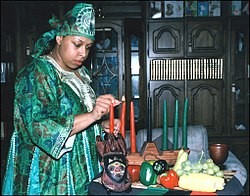
A woman lighting candles for Kwanzaa. The black candle in the middle represents unity, the three green candles on the right represent earth, and the three red candles on the left represent the struggle of African Americans or the shedding of blood.[20]
Families celebrating Kwanzaa decorate their households with objects of art, colourful African cloth such as kente, especially the wearing of kaftans by women, and fresh fruits representing African idealism. It is customary to include children in Kwanzaa ceremonies and to give respect and gratitude to ancestors. Libations are shared, generally with a common chalice (Kikombe cha Umoja) passed around to all celebrants. Non-African Americans also celebrate Kwanzaa.[2] "Joyous Kwanzaa" may be used as a greeting during the holiday.[21][22][23]
A Kwanzaa ceremony may include drumming and musical selections, libations, a reading of the "African Pledge and the Principles of Blackness," contemplation on the Pan-African colours, discussion of the African principle of the day or a chapter of African history, a candle-lighting ritual, artistic performances, and, finally, a feast of faith known as Karamu Ya Imani.[24][25] The greeting for each day of Kwanzaa is Habari Gani?,[26] which is Swahili for "How are you?"[27]
At first, observers of Kwanzaa avoided the mixing of the holiday or its symbols, values, and practice with other holidays, as doing so would violate the principle of kujichagulia (self-determination) and thus violate the integrity of the holiday, which is partially intended as a reclamation of important African values. Today, some African American families celebrate Kwanzaa along with Christmas and the New Year.[28]